It shone in the darkness like a Christmas tree: after the Russians dropped three 250-kilogram KABs (guided aerial bombs) on the lyceum, lights in all its windows blazed on simultaneously. This was how Krasnopillia Lyceum No. 1, which had been the heart of the settlement for years, said its goodbye.
The enemy tried to erase modern physics, chemistry, and biology classrooms, IT suites, and the resource room with aerial bombs, cynically labeling the elite institution a “secret laboratory.” This is the story of its principal, Olena Anatoliivna, about how to teach children to believe in the future during online lessons amidst the ruins, and why the occupiers are actually so terrified of Ukrainian education.
The Cradle That Raised Generations
Krasnopillia. Sumshchyna (Sumy region). Only ten kilometers to the border with Russia. Krasnopillia Lyceum No. 1 became the center of life for the entire community.
In 1984, smaller educational institutions were merged into one. High school students from surrounding villages were brought here. The projected capacity of the institution was 1,100 students. Education here was always a matter of honor.
The staff did not shy away from any work. Teachers repaired the premises, landscaped the grounds, and planted flowers in the flowerbeds with their own hands. Every year, the school won grants and joined a number of projects. For example, thanks to the “Capable School” program, they acquired a modern linguistic laboratory for English and a new mathematics classroom. The linguistic class had everything needed: 15 equipped stations for students and a separate one for the teacher.
“For our settlement, it has always been the cradle of education,” says the lyceum’s principal, Olena Anatoliivna. The team consisted of 112 employees—specialists who lived and breathed the school.
In 2017, the lyceum entered the top 100 schools of Ukraine. It became a pilot institution of the New Ukrainian School. Delegations of various levels, including ministers, visited Krasnopillia. Then came the “Great Construction” (Velyke Budivnytstvo)—a complete modernization. The lyceum received multimedia equipment and a fully equipped workspace for every teacher.
Modern physics classrooms, two chemistry laboratories, three IT classes, and biology and mathematics classrooms appeared. A special source of pride was the resource room for children with special educational needs. “We never refused anyone because everyone has the right to education,” Olena Anatoliivna recalls. Parents happily entrusted their children to the lyceum because they knew about the individual approach and the atmosphere of love.
The assembly hall with 360 seats was impressive. A motorized screen, a projector, modern furniture. Everything was modernized to such an extent that it resembled educational “postmodernism.”
Every wall color, every blind was thought out to the smallest detail.
“Everything was done. Everything. We were almost finished.”
The completion of the work was planned for May 30, 2022.
It was not meant to be.
February 24: a tank and flowers
The war began at four in the morning. Olena understood it instantly—hearing the first explosions, she shouted to her husband: “It’s war!” He didn’t believe it. Her son in Kyiv, whom she called a moment later, answered briefly: “Mom, I know.”
The settlement was not occupied, but the enemy surrounded it. Checkpoints. Planes. Columns of heavy machinery. The principal still remembers the evening of February 24. Eleventh-graders called her. The children’s voices trembled: “Olena Anatoliivna, there is a tank standing there, and its barrel is pointed at our school. What should we do?”
In that moment, she was terrified for the children. She began to beg and plead with them: “Please, get away from there! We will rebuild, we will do something. Just leave.” But the teenagers did not retreat. Their hearts ached for their school: “Olena Anatoliivna, they are going to fire right now!” She had to call their parents immediately. To ask them to take them away, to bring them to their senses. The youthful desperation was too dangerous.
While the settlement shuddered from the roar, Olena Anatoliivna went to school every day. Despite the fear. Despite the planes overhead. She opened the heavy doors and found herself in the silence of empty corridors. A real winter garden grew in her office. The principal loves flowers very much.
She slowly walked around every pot. “I walked, watered the flowers, and cried. I touched the walls and cried.” This was her silent prayer. As long as she waters the flowers, the school lives. As long as she touches the walls, the lyceum stands.
In 2023, there were already strikes on the settlement. Windows cracked. But the lyceum held on. Teachers took shifts, watching over the equipment. The lyceum became a volunteer hub. When “Shaheds” destroyed the local hospital, school buses were used for evacuation. Patients with limited mobility were placed on blankets right in the aisles between the seats. The lyceum’s shelter, designed for hundreds of people, hosted 40 residents of the settlement every night who were fleeing artillery shelling. It was equipped according to all requirements. People came here just to live. That was how it was until November 7, 2024.
November: Autumn Glow
November 7, 2024. 11:00 PM. It was just Olena’s husband’s shift—he worked at the lyceum as a guard. She called him after seeing a message in Telegram channels about the threat: “They are writing—KABs heading for Krasnopillia!” He disliked the shelter, but this time he obeyed. He started to go down but didn’t manage to hide completely. The bombs arrived instantly. Powerful explosions rang out, shaking the entire settlement. Contact with him was lost.
Olena Anatoliivna, together with her deputy, immediately drove to the lyceum. Rescuers from the State Emergency Service (SES) were already working there. In the darkness of the night, since the power was cut, the scale of the destruction was hard to comprehend. Suddenly, something incredible happened in the empty institution—perhaps due to a short circuit, all the light bulbs flashed on at the same time. “I don’t know the reason, but it shone like a Christmas tree. Every single bulb lit up. The building was visible for several kilometers. People from afar thought it was burning, but it was as if it was saying goodbye to the settlement.”
Olena’s husband was found alive—it was a miracle he managed to take cover at the last moment. While they were at the site, people started calling en masse, but suddenly a shout rang out: “Threat of a repeat strike!” “It was a true horror. We started running, falling somewhere right in the dark. Eventually, the SES officers sent us away, saying: ‘Go, it is simply dangerous for you to be here right now.'”
At 7:00 AM on November 8, the entire staff was already at the school. Residents of the settlement came too. “There was no principal, no teachers. We were all one family. We stood shoulder to shoulder.”
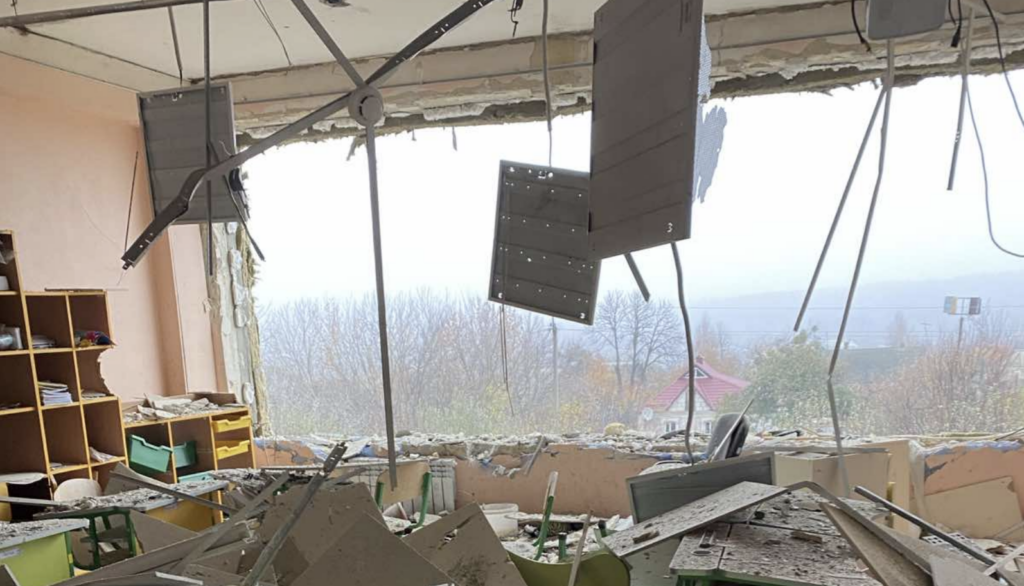
Three KAB-250s were dropped on the lyceum. One did not explode, going deep into the ground, but two mutilated the school garden. Young apple trees that were already bearing fruit were torn out by the roots. The force of the impact was such that the trees literally drove into the school’s cladding − they just stuck out of the walls. Laptops and modern ‘LabDiscs’ inside were shredded like paper.
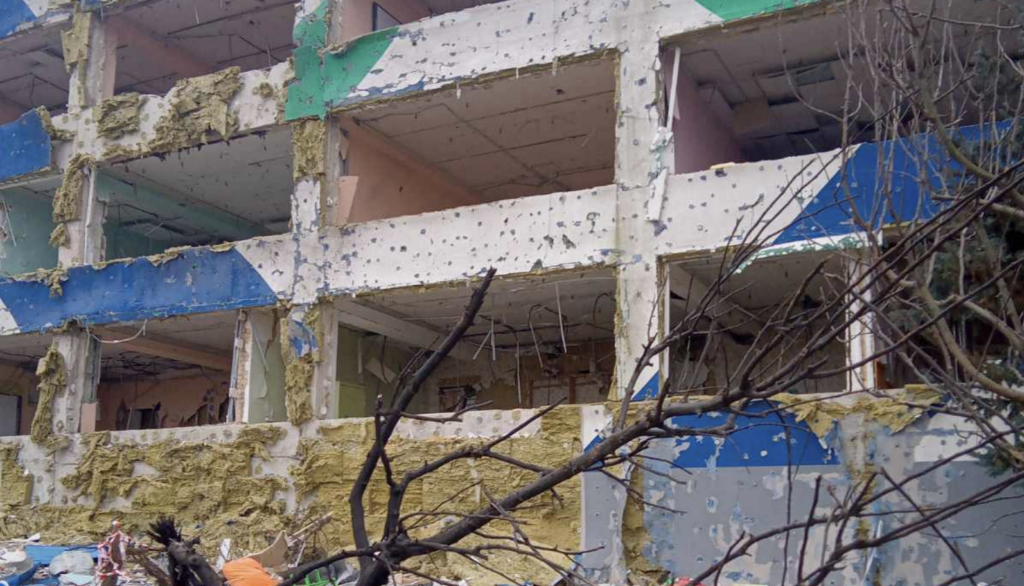
In five hours, before lunch, thousands of hands cleared three floors and the ground floor of broken glass. The walls were peppered with sharp fragments that stuck into the concrete like needles. The partitions were completely blown out, and in the elementary classes on the stadium side, everything was smashed by shrapnel. Due to the powerful blast wave, the floor in the corridors went in waves: the slabs were overturned and lifted up.
Nearby, the teacher Lilya Viktorivna was crying. The KABs mutilated her little house, where she lived with her 90-year-old mother, a librarian. The house stood shattered, but the woman could not take her eyes off the ruins of the lyceum. Despite the pain, the first hope appeared: familiar military guys, who in civilian life were builders, inspected the damage and said confidently: ‘It can still be restored. The school is sound and beautiful − we will do everything, it will be reborn’.
At 15:00, when the staff and parents − about 30 people − were waiting for building materials to board up the windows, another notification arrived: a KAB on Krasnopillia. This time, a 500-kilogram bomb hit the school.
− ‘I don’t know how we stayed alive. We made it. We jumped into the shelter. A second − and an explosion rang out. A terrifying one. Acrid smoke billowed. The smell of sulfur. Cartridges showered down from the concrete onto our heads.’
Communication in the settlement disappeared. Olena conducted a roll call right in the shelter. She was most afraid for the two school bus drivers, whom she couldn’t find among the people. For a while, they sat in the basement − those who felt unwell were given water and calmed with medicine by a nurse who, fortunately, was nearby. Only when they were certain the threat had passed did they begin to come out.
And the residents of the settlement were already running to meet them. They grabbed the teachers by the shoulders, not believing their own eyes. Before the eyes of all Krasnopillia, the walls of the lyceum simply fell, and huge concrete slabs of one of the wings collapsed in an instant. In the crowd, people frantically shouted only one question: ‘Is everyone alive?’. Olena Anatoliivna, overcoming the shock, repeated over and over: ‘Alive.’
The principal was in a state of stupor. Her colleagues put her in a car to immediately take her out of the danger zone due to the threat of a repeated strike. Only after a few minutes did she feel that she was sitting on a pile of broken glass. From the shockwave, absolutely all the windows in the car had blown out.
Later, the Russians laughed in their Telegram channels, reporting the ‘destruction of a secret biochemical laboratory’ in Krasnopillia.
− ‘It was simply ridiculous. There were no military facilities. It’s a typical building − only a stadium and a school nearby,’ Olena Anatoliivna notes with bitterness. − ‘The most cynical part is that these ‘lab experts’ were still walking to our place across the border just yesterday. They came in droves to our shops, bought our candies and sausages, because they knew that everything in Ukraine is high quality. They knew perfectly well where the school was and where the shop was. They are simply afraid of our education and our level of knowledge.’
Night of Unity and Morning of Action
November 8. Evening. Online teachers’ council. The dust from the collapse hadn’t even settled, yet the team had already gathered online. Teachers turned on their cameras—and in every monitor window, there were tear-stained eyes. It was a moment of the highest pain, but at the same time, the greatest unity.
Decisions had to be made on how to work further. Parents wrote in chats that children were sobbing for “their beautiful school.” “We took a week of time-out—it was too difficult to go out to the students immediately. We needed to recover, to set up distance learning in new conditions. But it was the children who gave us strength. When you see this despair in children’s eyes, you realize: you have no right to break.”
The very next morning, at six o’clock, Olena was at the ruins. The team came on their own—without any orders or calls. People pulled employment record books and personnel files from under the concrete slabs with their bare hands. Documents were taken to homes to be dried and to save at least something.
Everyone acted automatically. For the principal, it was a matter of honor. Walls can be rebuilt, but trust cannot. “Throughout the war, I was most afraid for the people. If something had happened to them—how would I walk this earth afterwards? I simply wouldn’t be able to. But as it is—we are alive, and we continue to teach.”
March 2025: Phoenix Under Fire
If the November strikes mutilated the lyceum, then in March 2025, the enemy decided to “finish it off.” More than ten KABs hit the institution. Olena was in Kyiv at that time due to health problems. She gave testimony about the war crime at the Shevchenkivskyi Police Department.
“When I showed photos of our lyceum to the Kyiv police officers, they were amazed. They said: ‘We have few such modern schools in Kyiv as you had.’ It hurts to hear this word—’had.’ But we do not allow ourselves to think that way.”
Out of 112 employees, 100 were retained. The teaching staff held on almost completely. Older retired teachers voluntarily gave their hours to younger colleagues who have children so that they would have the means to survive.
Verbs of the Future Tense
Olena Anatoliivna continues to teach the Ukrainian language. She recalls a lesson in the seventh grade, immediately after the destruction of the lyceum. The topic—verb forms. The task—to compose sentences.
“I tried so hard not to focus attention on the tragedy, on our institution… I greeted them, made sure all the kids were safe, and started working. But they… They started composing sentences about the school themselves.”
The statistics are painful: in 2022, 800 children studied at the lyceum. Today, exactly half remain—401 children. “Some come, take their documents, and apologize. I understand them. Unfortunately, a terrible fate awaited us. But we continue to work for the sake of those who remained.”
The school keeps a record of every student. The majority of families evacuated within the region—to the safer Romenshchyna and Okhtyrshchyna districts. In addition, 60 students of the institution are currently abroad, but they have not left the lyceum—they continue to study there remotely.
Today, the tragedy of the Krasnopillia Lyceum is known in Canada, the Netherlands, and France. Olena and her team make videos and reach out to international organizations. Graduates of the lyceum who live abroad promise to help with the restoration. “We believe that the lyceum will be reborn. As long as this small flame of hope burns in us, we work. Sometimes it is hard, but I feel colossal support. There are such people next to me that I simply cannot afford to give up.”
The material was prepared by Nataliia Chufeshchuk based on the results of a field mission within the framework of the project “Strengthening Civil Society Resilience for Justice and Accountability,” implemented by the Educational Human Rights House Chernihiv with the support of the National Endowment for Democracy (NED).