Testimony of Natalia Bortnyk, deputy head of the Narodychi settlement military administration, on how residents of border villages survived the first days of the war and the occupation
Borderlands shaken at dawn
February 24, 2022, five o’clock in the morning… The village of Radcha in the Zhytomyr region, located close to the Belarusian border, became the first settlement in Ukraine to be shelled by the Russian occupiers.
‘We woke up to the sounds of shelling. We didn’t know what to do: whether to get dressed or run out of the house, because everything around was just red. My first impression was that we wouldn’t even be able to get out of the house into the street. It was very scary,’ recalls Natalia Bortnyk, deputy head of the Narodychi settlement military administration.
Mrs. Natalia has lived her whole life in the village of Nova Radcha. February 24, for her, as for thousands of other Ukrainians, became the day that changed everything.
Her husband insisted on standing in the doorway — ‘just in case, the house might collapse.’ Their son, waking up from the explosions, hurried everyone: ‘Faster, faster!’ At about half past four in the morning, the family started the car and drove to Narodychi.
‘Many cars from the village were driving along the road,’ Natalia recalls.
A school bus from an occupied village: salvation for local residents
Realizing the scale of the threat, Natalia immediately called the school driver, Mykhailo Lukyanenko, who lives nearby. She asked him to drive around the villages in the school bus.
‘He started the bus, drove through Nova Radcha, Radcha, Hrezlia, Davydky, honking along the streets. Whoever wanted to, came out. People also didn’t understand what was happening. The bus was filled mostly with young women and children,’ Natalia says excitedly.
Around eight in the morning, a bus with terrified people arrived in Narodychi. There was still a signal; Natalia called the clerk, Iryna Yevhenivna, asking them to drive faster. At that time, everyone still thought they would return home by evening.
Despite the danger, Natalia, her husband, and their son decided to return home for essential items. They didn’t know if the village was occupied.
“We ran into the house quickly, throwing clothes and whatever food we could from the fridge into the car. It was very fast, efficient,” she recalls.
On the way back, they stopped at the Radcha intersection, where a large police van was parked. Natalia’s husband got out of the car to talk to the police officers. Their son shouted: “Hurry up, heavy machinery is coming!”
“I remember those words so clearly — heavy machinery is coming. Something was rumbling there. As we got closer, we could indeed hear a massive roar on the asphalt — heavy machinery was coming from the direction of the Kyiv region,” Natalia says.
Twenty minutes after their departure, they received a call in Narodychi: the police car and two “Duster” vehicles from the forestry office had been shot. A deputy jumped out of the forestry car and spent more than a week fleeing through the forests. People thought he was dead.
By 11 a.m., the signal was lost. The villages were occupied.
From an empty basement to a life-saving home: how the community created a shelter in one night
On the first day of the occupation, about 100 evacuees were housed in the basement of the Narodychi hospital. Natalia, along with the hospital director, Mariia Ivanivna, urgently began equipping the basement.
“People had nothing at all. Just some light shoes and whatever clothes they were wearing,” recalls the deputy head of the administration.
Later, washing machines were installed there, and a small canteen was organized. Volunteers brought food, and local residents of Narodychi actively helped. The former director of the forestry office, Ruslan Antoniuk, also supported the evacuees, as many of the workers were from his enterprise.
Nataliia wrote on Facebook that clothing was needed. People started bringing things, later volunteers joined, and humanitarian aid arrived. Hot meals were organized at the hospital three times a day.
“It was impossible to ask people from the basement to come outside. They would go out, but they didn’t want to. They were very frightened. We said: ‘Go, there are empty wards, stay the night, rest!’ ‘No — we will only stay in the basement…’” she recalls.
Evacuation abroad: a journey into the unknown
In March, Nataliia personally organized a trip abroad for mothers with children. She was on the phone 24/7, collecting data. She sent two school buses (about 50 families) to the Czech Republic.
“We sent mothers with small children at our own peril and risk,” she recalls.
The most terrifying moment was when two buses with children were traveling at three in the morning, and a drone was hovering over them.
“We didn’t understand whose drone it was or what kind of drone it was. I’m driving and thinking: if it hits now, and there are two buses of children. It was very scary!” says Nataliia.
She admits that she doesn’t know if she would take on such responsibility now…
She searched for volunteer contacts in the Czech Republic on her own. She didn’t know where she was sending them or to whom. “I was on the phone 24/7. Everything was done over the phone. Without knowing the person, never having spoken to them. Now I think: God, it’s just a nightmare,” Nataliia recalls.
Later, there were many grateful calls and feedback from fellow villagers who managed to be evacuated.
Convoy of hope: the path from Narodychi to safe cities
At the end of March, Nataliia organized the relocation of people to Zhytomyr so they could rest a bit from the basement.
“Again, I get into my own car and drive ahead of the school buses. We drove blindly, not knowing the situation in the direction of the regional center. On the roads, there were only soldiers with automatic rifles,” she recalls.
Police Chief Oleksandr Kulish escorted them to Korosten, and then they drove on their own. In Zhytomyr, there were checkpoints everywhere, a lot of military, and almost no car traffic.
People were settled in a sports lyceum, later moved to Novohrad-Volynskyi, where they stayed at a military college until April. They were received very well, provided with humanitarian aid, food, and clothing.
Life under occupation: fear and survival
In five villages: Radcha, Stara Radcha, Nova Radcha, Hrezlia, and Davydky, about 60 people remained. According to the stories of those who survived the occupation, people were very worried, afraid, and practically did not walk the streets.
«The occupiers drove in their vehicles and threatened the villagers not to hide in cellars, or they would be shot,» — Natalia conveys the words of eyewitnesses.
Two people, a man and a woman, who were walking along the road in the village of Nova Radcha, were shot. Locals buried them, and later there was a reburial in Narodychi.
In the village of Radcha, the mother of a local resident died; she was buried in the yard, and after liberation, she was reburied in the cemetery.
The death of a former school employee and music director, Vasyl Ivanovych, was tragic. He and his wife were under occupation. A shell hit their yard, not the house, but an outbuilding. Shrapnel wounded the man. He was buried in the yard and later reburied.
«Perhaps if there had been medical workers, Vasyl Ivanovych would still be alive today, but since there was no one to help, he simply bled to death and died,» — Natalia says.
After three weeks of occupation, people began to flee through the forest to reach at least Narodychi. They walked for two days.
«Iryna Yevhenivna, the village council clerk, and her husband also fled through the forest. I remember how they got here, very frightened,» — Natalia recalls.
It was cold. Natalia’s neighbor and her husband barely reached the hospital. The woman fell ill and was treated for a long time.
Between fear and home: a mother’s choice
The situation with one family from Davydky is especially painful for Natalia. Almost all residents stayed put then. Only a few families with children got on the bus and evacuated.
Among them was one family — a mother with children. But later the husband arrived and took them back.
«I remember this very well, when I called Oleksandr Oleksiiovych, our police chief, so that he could influence the situation,» — Nataliia says.
A month later, they were already fleeing from there through the forest.
«I say: «Svitlana, what have you done? I asked you: don’t go, after all, there are children.» She just nodded her head. Terrible things were happening there,» — Nataliia recalls.
In Davydky, half the village was wiped out — more than twenty houses were completely destroyed.
When home becomes a target
Looting did not affect everyone, but it left those it did affect with nothing. Nataliia tells about her own experience reluctantly: years have passed, but it is still painful to remember.
«Everything that my husband and I had accumulated and bought over 30 years was stolen from the house,» — she says.
An interesting feature was the «selective» nature of the thefts. For some reason, the refrigerator and the TV were left, but they took the tools belonging to her husband and son, various spare parts, keys, a car wash, gas generators for light, and chainsaws.
They didn’t touch her husband’s or Nataliia’s clothes, but their son was left with nothing. «His clothes are greenish in color, similar to a military uniform, because he works in the «Drevlianskyi» nature reserve. Combat boots, sneakers… They took absolutely everything,» — Nataliia recalls.
«All the dishes were broken and smashed. Pillows, blankets, bedspreads — it was just bare. They committed such mockery in the house,» — the woman describes the consequences.
Surprisingly, at her mother-in-law’s house, who lives nearby on the same street, everything remained almost untouched. «The doors were broken, some towels and small items were stolen, but otherwise things were in place,» — Nataliia says.
In the village of Hrezlia, the picture was similar. In two houses, looting was organized: «… they would come and load everything in a row into cars. Stores were opened and looted indiscriminately.»
Black road: from mine fields to abandoned trenches
The village was liberated on April 3, but the local administration was only allowed to enter on April 5. During those days, they collected humanitarian aid: food parcels for those who remained under occupation. They knew approximately how many people were there. A small group went to the village: Oleh Ivanovych, head of the military administration, Nataliia with her husband and son, police chief Oleksandr Kulish, and deputy Ihor Odynokyi. They took a large vehicle to load all the packages.
“We arrive, and everything is pitch black, starting from Zalissia. Even the asphalt isn’t what it used to be…”, Nataliia describes her first impressions.
The road to Hrezlia was dug up, the asphalt destroyed. “There were so many mines. By that day, the sappers had already removed some mines from the roadway and cleared the road,” the woman recalls.
In the village, there were dug-in enemy trenches, huge pits on both sides, and shell holes in the roofs of houses.
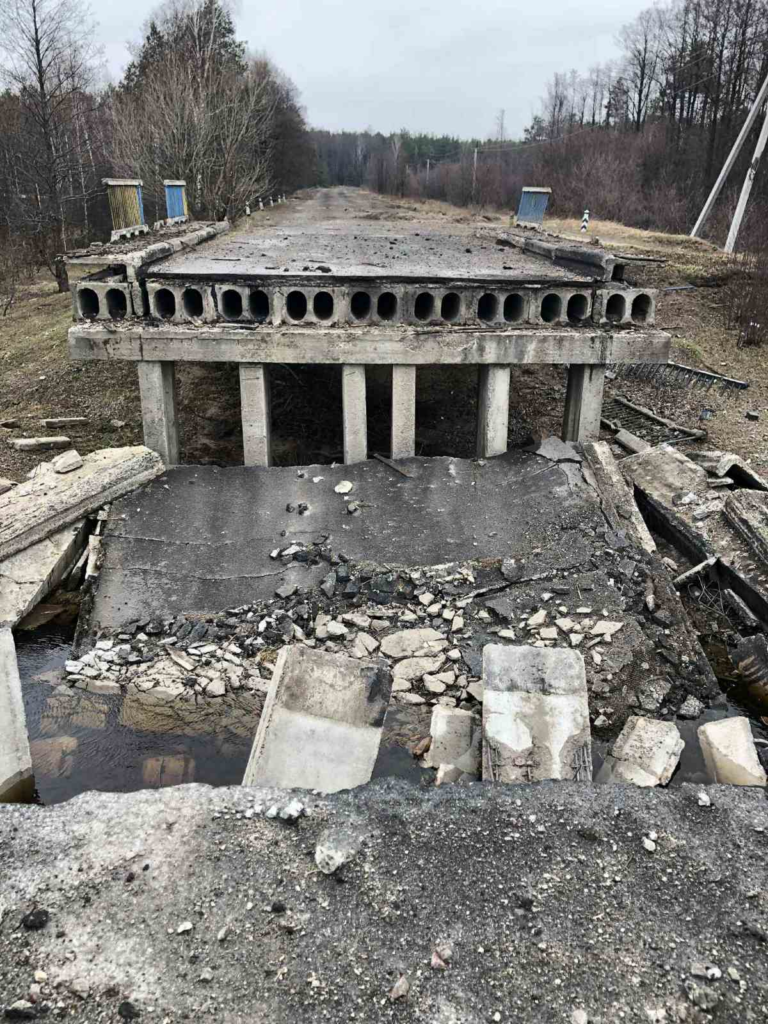
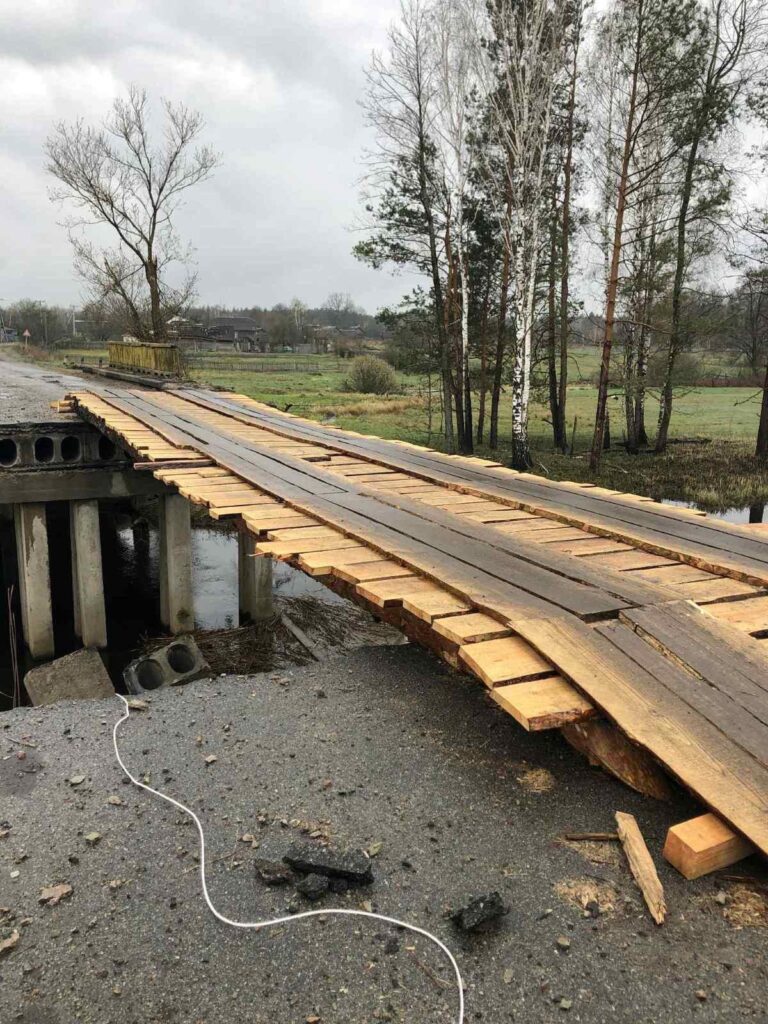
“We approach the bridge, and there is no bridge. The bridge is blown up,” says Nataliia. In total, three bridges were blown up in the area: in Hrezlia, Nova Radcha, and the one leading to Kyiv.
They crossed the river via a small footbridge, walking through the forestry area where Ukrainian troops were already stationed. The commander helped carry the bags. They had to walk about five kilometers.
“We reach the intersection, and it’s just horrific!” Nataliia recalls.
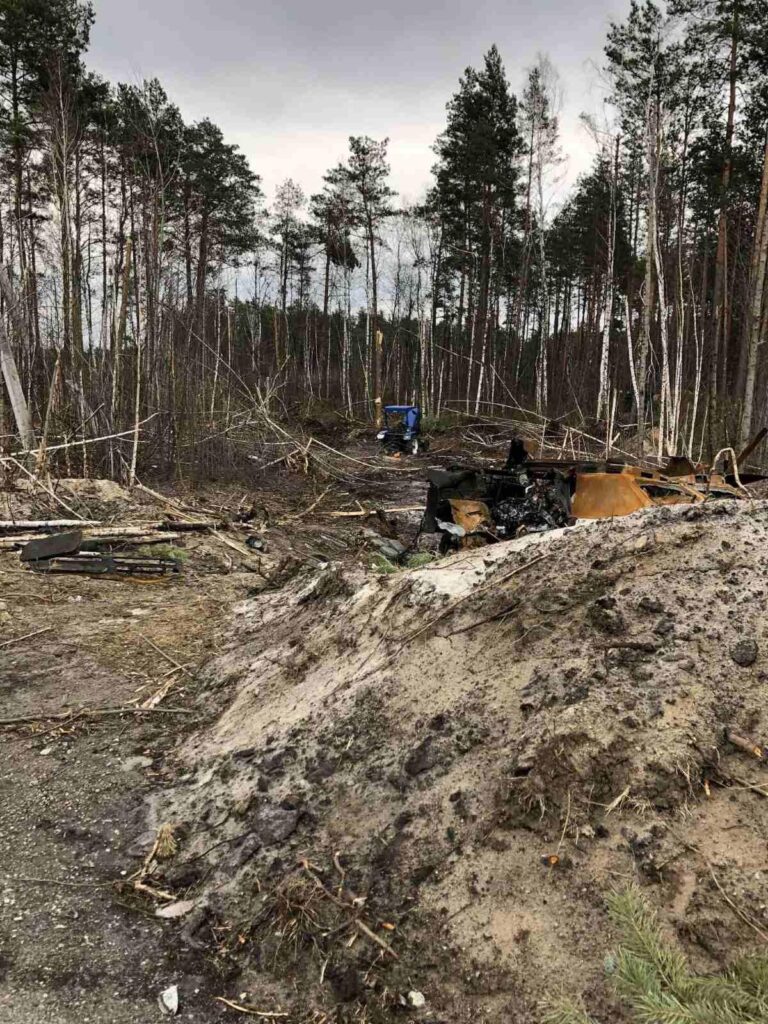
Shot-up vehicles were everywhere: police cars, two “Dusters”, an IFV, and a civilian van. Nearby was an enemy IFV with the letter “V”, also shot up. Deeper in the forest lay the destroyed equipment of the Russians.
Amidst all this scrap metal stood a shot-up tractor that they had stolen from Nataliia’s yard. “They probably used it to haul logs and build bunkers,” the woman assumes.
In the enemy bunkers, they found traces of a hasty retreat: “The food had solidified on the plates…”. Abandoned spoons, salads, canned goods, and a vast amount of medicine were scattered at the intersection. Assault rifles lay everywhere, which the military later cataloged and removed.
A month for restoration
Immediately after the de-occupation, they began to restore the most necessary: gas supply, electrical grids, and communication. «Within a month, almost everything was restored, although it was very badly damaged,» — Nataliia says.
The hardest part was with the gas services — they didn’t want to go because everything was mined. “It was so heavily mined that people were very afraid,” the woman recalls.
Electricians were constantly encountering tripwires. The story of one family from Hrezlia became a tragedy: “They were escaping and were injured by tripwires. The whole family was blown up. But the occupiers took them to Belarus for treatment. Later they returned.”
Eventually, the entire infrastructure was restored. Communication, light, and gas appeared. The post office is now mobile — it comes to the people, as many pensioners still receive pensions via payroll sheets rather than cards. Mobile shops and stores are operating.
Bridges were restored in stages.
“I was powerless”
The most painful things for Natalia were the accusations from some people, as if she were to blame for the fact that people remained in occupation.
“I couldn’t help with anything, I just couldn’t. If I could, I would have helped. I was powerless. It was very hurtful,” she says.
Mrs. Natalia calls the forester Oleksandr Chornovol, who was given an award by the president, a true hero. He actively helped the military and led many people out of the occupation through the forest in late March.
New challenges of peacetime
Almost everyone returned after de-occupation. Only a few families with children remained abroad.
The village of Davydky suffered the most — over twenty houses were completely destroyed. Many buildings were restored through charitable foundations, particularly “Caritas.” Those who had critical damage bought housing elsewhere — mostly in the Kyiv region, some in Zhytomyr.
Now the roads have become the biggest problem.
“People approach us most with this issue. Especially early in the morning, when everyone is going to work. When the fortifications were being built, there was more traffic than in Narodychi,” Natalia adds.
Forty days of Radcha’s occupation will remain in memory forever, but life continues. The village is being rebuilt, people are returning, and children are going to school.
The red sky of February 24 is gradually changing into hope for a peaceful tomorrow.
This material was prepared by Iryna Hubar and Olha Halenchyk based on the results of a field mission within the framework of the project «Strengthening Civil Society Resilience for Justice and Accountability», implemented by the Educational Human Rights House — Chernihiv with the support of the National Endowment for Democracy (NED).